Jack Lundstedt Titi, CEO and Co-Founder, Vetz
Vetz's co-founder on why a vet consultation is harder to transcribe than a GP's, juggling languages mid-appointment, and why "AI scribe" will soon feel outdated.
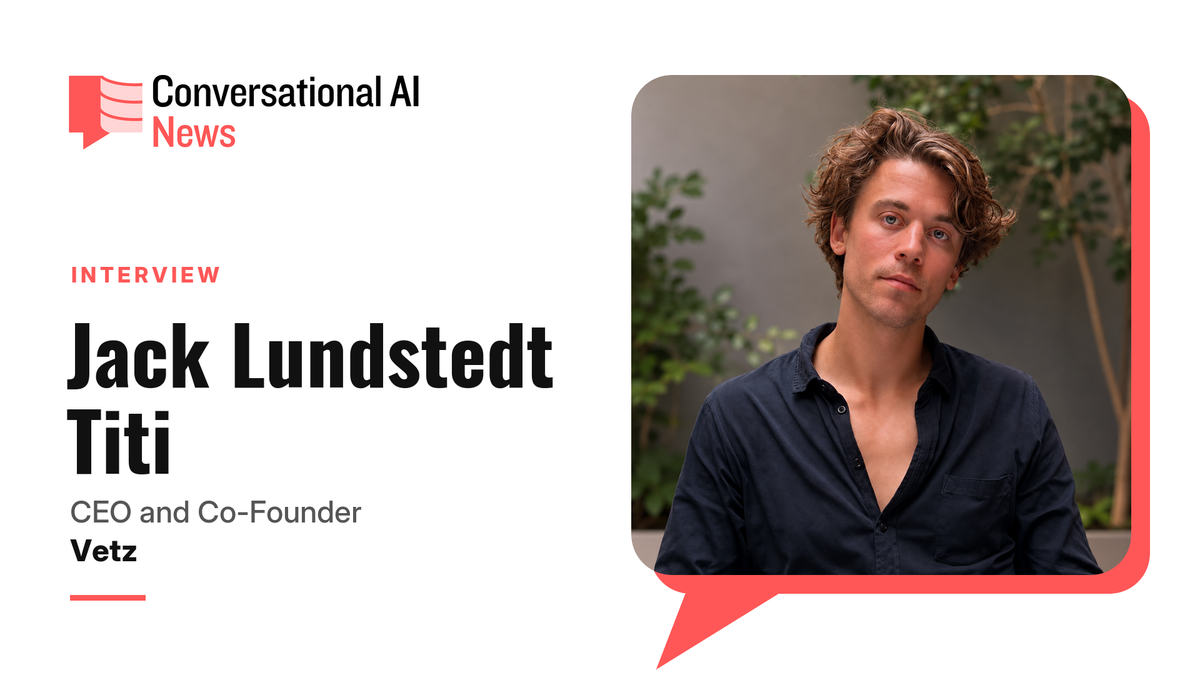
Jack Lundstedt Titi is CEO and co-founder of Vetz, a Stockholm-based AI platform for veterinary clinics that turns recorded consultations into structured clinical notes. Vetz works with clinics across the Nordics and Germany, and is listed in the Conversational AI News vendor marketplace. Here Jack explains what makes a vet consultation harder to transcribe than a GP appointment, how Vetz handles several languages in one conversation, and why he thinks the term "AI scribe" will soon feel outdated.
My questions are in bold — over to you Jack:
What's your background, and how did you come to co-found Vetz?
My background is in product and technology, and I've worked across gaming, banking and pet insurance.
Douglas (co-founder & CTO at Vetz) and I have known each other since we were kids. When we were both studying at different universities in the US, we built a non-profit app together that connected senior citizens with shelter dogs for walks. The idea was to help reduce loneliness while also helping dogs get out of the shelter environment.
That was probably the first thing that really got us interested in the pet space.
A few years later, we started an insect-based dog food brand together. Through that, we got to know a lot of people across the pet industry, including researchers and veterinarians, and got a much better understanding of the industry and some of the challenges clinics were facing.
When generative AI started becoming genuinely useful, veterinary care felt like a very natural place for us to look. We already knew the industry, we knew people working in it, and there was a very clear problem: veterinarians were spending far too much of their time on documentation and administration rather than with their patients.
That's really where Vetz started.
Tell us about Vetz - what the company does, who it works with, and where it is today.
Vetz is an AI platform built for veterinary clinics, and veterinarians in particular, although we support essentially any role at the clinic.
We started with the AI scribe. A veterinarian records a consultation and Vetz turns it into a structured clinical note based on how that veterinarian or clinic wants its medical records to be written.
Since then, we've built quite a lot around that. We provide live support during consultations, research and knowledge search, AI agents that clinics can configure for different use cases, and integrations with practice management systems and other tools they already use.
We also help clinics make better use of the data they generate in Vetz. That includes surfacing actionable insights around how the clinic is working and where it can become more efficient, as well as supporting workflows such as invoicing pet owners.
The idea is that Vetz should become an assistant for the clinic throughout the day. We want to remove as much unnecessary admin as possible and fit into the workflows and systems clinics already have, rather than asking them to change the way they work around us.
Today we work with clinics across the Nordics and Germany, and we're expanding further across Europe. Vetz is used in thousands of consultations every month by everything from small independent clinics to larger veterinary groups and animal hospitals.
Take us under the bonnet. Between the vet pressing record and the finished note landing in the practice management system, which parts are speech recognition, which are language models, and what did you have to build yourselves rather than buy?
There are a few different layers.
First you have the speech-to-text layer, which turns the consultation into a transcript. Even that is harder than it sounds in veterinary medicine. You have several people speaking, background noise, medical terminology, breeds, drug names, abbreviations and quite often several languages being used during the same consultation.
Then you have the language-model layer. That's where you need to understand what in that conversation is actually relevant to the medical record, what the owner reported versus what the veterinarian observed, and how all of that should be structured according to the clinic's preferred way of writing notes.
Where we've spent most of our time, and where I think we've built a real advantage, is everything that makes those technologies actually work in veterinary care.
That's things like veterinary terminology, clinical structure, context, templates, clinic and user preferences, evaluation, guardrails, model orchestration and integrations into the systems veterinarians are already working in.
We've now processed a very large amount of real veterinary consultations across different languages, specialties and types of clinics. That experience matters a lot.
It's relatively easy to build something that produces an impressive-looking medical note in a demo. Building something a veterinarian can rely on every day, across thousands of real consultations, is a completely different problem.
Once the draft is ready, the veterinarian reviews it and can send it directly into the practice management system through our integrations.
Why start with vets rather than human healthcare, where ambient scribes are already a crowded market?
That was actually part of what made it interesting.
Human healthcare is obviously a massive market, but there are already a lot of very well-funded companies competing there.
Veterinary medicine has many of the same problems, but historically there has been much less technology investment.
And the need is very real. Burnout is a major issue in veterinary medicine, staff turnover is high, and there's a shortage of veterinary professionals in many markets.
At the same time, veterinarians spend a large part of their working day writing notes and doing administrative work.
So if you can give a veterinarian one or two hours back every day, that has a very tangible impact. Of course there is a financial value for the clinic, but for the individual vet it might mean actually having time for lunch, being more present with the next patient or being able to leave work on time.
We also realised quite quickly that veterinary medicine has enough unique challenges that you can't just take a scribe built for human healthcare and put a veterinary label on it.
A vet consultation is a three-way conversation - the vet, the owner, and a patient who can't speak. What does that do to transcription and note-writing that a GP scribe never has to deal with?
It changes quite a lot.
In human healthcare, the patient can normally explain what they're experiencing. In veterinary medicine, the owner is describing and interpreting the behaviour of an animal that obviously can't tell you where it hurts or how it's feeling.
Then the veterinarian adds another layer based on what they see and find during the examination.
So you need to understand the difference between something the owner is reporting, something the veterinarian is observing, the clinical assessment and then the plan.
The notes also tend to be much more detailed.
If I look at my own medical record after visiting a doctor, there are visits where the doctor has basically written one sentence. You'd very rarely see that in veterinary medicine.
Because the patient can't explain their own symptoms, there's a much greater need to document the history, observations and examination properly. It both increases the amount of documentation and makes accurate notes even more important.
And then there's the practical side of it. Dogs bark, cats move around, equipment makes noise, owners interrupt each other and sometimes several people are in the room.
On top of all of that, the system needs to understand terminology across completely different species, breeds, medications and specialties.
So it's a pretty demanding environment.
You work across the Nordic countries. How hard is it to get clinical terminology right in several languages, and where does the AI still get it wrong?
It's definitely one of the harder parts, but it's also something we've spent a lot of time on.
Today Vetz supports 14 languages, and we're particularly good at handling several languages within the same consultation.
That's important in veterinary care. We have plenty of veterinarians working in Sweden, for example, whose first language isn't Swedish. You might have a consultation mainly in Swedish, then the veterinarian switches to English for a certain term, the owner responds in another language, and Latin medical terminology is mixed in throughout.
So we've put a lot of focus into accents, dialects and multilingual conversations rather than assuming everyone in the room is speaking one language in exactly the same way.
Then you have clinic-specific terminology. That's probably one of the more interesting challenges. Clinics can have their own abbreviations and internal language that might not mean anything to someone outside that clinic.
That's why users can add their own terminology and abbreviations to Vetz.
Context is a huge focus for us in general. The more Vetz understands about the clinic, the user, the patient, the type of consultation and how that clinic likes to work, the better it can perform. It also becomes more adapted to the clinic and its preferences over time.
We use veterinary-specific and language-specific datasets to complement that as well.
But expectations are important. If five people at one clinic have invented their own abbreviation, you can't expect a system to know what that means the first time it hears it. It needs that context.
When the scribe makes a mistake in a medical record, who catches it? How do you stop vets approving drafts without reading them properly?
Ultimately, the veterinarian does.
We're very clear that Vetz creates a draft and that the veterinarian should review it before it becomes the final medical record.
The interesting problem actually comes when the AI gets very good. If the output is correct again and again, it's human nature to eventually pay a bit less attention.
I don't think there's one perfect solution to that, so we approach it from both the product side and in how we set expectations.
We make the review step explicit and make editing very easy. Users can also highlight words or sections they're unhappy with and give that feedback directly, which helps Vetz become better adapted to how that user and clinic want their notes written.
That's a big part of what we're trying to do: rather than treating every veterinarian exactly the same, the product should become increasingly personalised to the person and the clinic using it.
But I don't think we should ever get to a point where the message is that the clinician doesn't need to review anything.
The goal is to remove the mechanical work, not the clinical responsibility.
You've added diagnostic suggestions and research search on top of the scribe. Where do you draw the line between helping the vet and making the clinical call?
We want Vetz to be an assistant for the clinic at basically any touchpoint during the day, but we don't want to replace the veterinarian's clinical judgement.
For research and diagnostic support, our role is really about surfacing relevant information.
Today a veterinarian might check a book at the clinic, ask the person sitting next to them, post in a Facebook group or search through different online forums. Those methods can work, but they all take time and the information isn't necessarily always current.
We want to make that much easier.
If you're dealing with a certain case, Vetz should be able to bring relevant research, trusted sources and things that may be worth considering to you, without you having to spend 20 minutes finding it yourself.
When you're moving from patient to patient all day, that time really matters. Often the information already exists somewhere. The challenge is getting the right information in front of the veterinarian at exactly the right moment.
That's really how we think about the rest of Vetz as well. If we can remove friction around documentation, research, internal knowledge, invoicing or other repetitive administration, the veterinarian can spend more time focusing on the patient.
For me, the line is quite clear: Vetz can help surface and understand information, but the veterinarian makes the clinical call.
Give us one clinic you work with and what changed there - time saved, notes completed, or something you didn't expect.
One thing we noticed very early was that some veterinarians almost didn't know what to do with the time they suddenly got back.
They're so used to finishing one consultation, rushing to write the note and already being stressed that the next patient is waiting. Then suddenly the note is basically done and there's actually time to get a coffee.
AWAKE Animal Hospital is one clinic we work with. They're one of the leading animal hospitals in the Nordics and have always been very progressive when it comes to technology.
One of the biggest changes for them has simply been being able to be more present with the patient. The veterinarian doesn't need to split their attention between examining the animal, talking to the owner and trying to document everything at the same time.
That's particularly useful for specialists doing more complex procedures, where you really want their full attention to be on what they're doing.
Across our customers, we generally see around one to two hours saved per veterinarian per day. In our latest user survey, 87% said they felt less stressed during their workday when using Vetz. That's probably one of the numbers we're most proud of.
We're also starting to see clinics use Vetz beyond documentation. With our AI agents, for example, clinics can build internal onboarding assistants based on their own routines and processes. In an industry with high staff turnover, getting new people up to speed faster can make a real difference.
How are you using AI yourself - in running the company and in your own day-to-day work? Which AI tools do you rate, and why?
Constantly.
We're a small company, and I think AI gives small teams a level of leverage that would have been very difficult to have just a few years ago.
I use it for product work, strategy, research, customer feedback, writing, prototyping, preparing for meetings and challenging my own thinking. And we obviously use AI extensively in development as well.
Claude and ChatGPT are probably the two tools I use the most.
I really like Claude when I'm working with a lot of context or moving between product, design and development. ChatGPT I probably use more broadly across research, analysis, writing and just thinking through problems.
But the biggest difference for me isn't necessarily that AI makes one particular task 30% faster.
It's that the cost of exploring an idea is now incredibly low.
I can have an idea in the morning, research the market, challenge my own assumptions, work through the product experience, make a prototype and then have a very concrete discussion with our technical team about it incredibly quickly.
For a startup, that's a huge advantage.
What's next for AI scribes? Where will the technology be in two years, and what do most people get wrong about it today?
I think the term "AI scribe" will probably feel quite outdated soon.
Today, most people think of it as something that listens to a conversation and writes the note afterwards.
That's useful, but I think it's only the entry point.
The more interesting systems will understand everything happening around that consultation. Why is the patient coming in? What happened in previous visits? Is there something relevant in the medical history? What research would be useful right now? What needs to be documented afterwards? Does the owner need information sent to them? Is there admin work that can happen automatically?
At that point, the scribe becomes much more of an assistant or an agent.
I also think conversational AI, and voice AI in particular, is going to play a huge role.
A lot of the AI products we have today still favour people who are already quite tech-savvy. You need to open a tool, understand what it can do, know what to ask it and often know how to prompt it properly.
Voice changes that.
Everyone already knows how to talk. A veterinarian doesn't need to learn a new behaviour to have a conversation while examining an animal.
I think that means conversational AI can bring the benefits of AI to a much broader group of people than the early adopters who are already using ChatGPT every day and testing every new AI tool that launches.
And I think that's also what people get wrong about AI scribes today. They see the medical note as the product.
For us, the note is the starting point. It gives Vetz context about what's happening inside the clinic. Once you combine that with the clinic's own knowledge and data, external research, integrations and the right safeguards, you can start removing friction from much more of the working day.
Ultimately, the goal isn't to have AI do the veterinarian's job. It's to let veterinarians spend more of their time actually being veterinarians.
Many thanks to Jack for taking the time to share his insights with Conversational AI News. You can learn more about Vetz on their website.