American Express publishes framework to keep AI agents' purchases tied to what customers approved
Amex's Intent Intelligence framework captures what a customer approved before an AI agent buys, then uses it as a control through checkout.
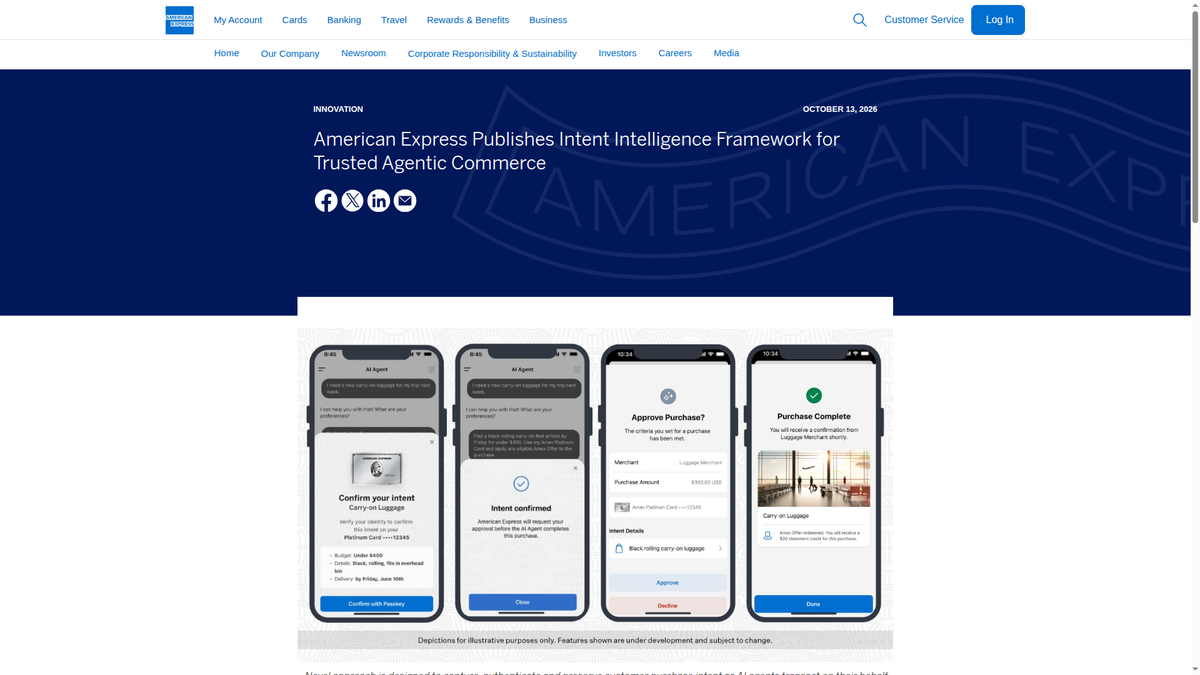
American Express has published Intent Intelligence, a framework for capturing and authenticating what a customer wants to buy before an AI agent completes the purchase, then carrying that approved intent through the rest of the transaction. Amex announced the framework on 13 October 2026 and has made it publicly available, saying it wants to help the industry settle on a common approach to intent in agentic commerce.
The difference from current implementations, according to Amex, is timing: the card issuer sees the customer's authorised purchase intent before the agent executes the purchase, so that intent can act as a control from start to finish.
How does Intent Intelligence work?
Amex describes four steps:
- Create and confirm intent. A Create Intent API captures the customer's instructions and constraints, such as the merchant, a maximum budget and other preferences. The customer then authenticates and signs off on the intent the agent has captured.
- Establish proof of intent. The system creates an Intent ID, a unique identifier for that intent, and a Proof of Intent Token representing its high-level constraints.
- Scope the payment credential. The token can be used to obtain a secure digital payment credential that the agent uses at checkout instead of the customer's card number, scoped to what the customer approved.
- Apply intent throughout the transaction. The Intent ID and token can be checked at later stages of the purchase, supporting fraud prevention, authorisation decisions and dispute resolution.
Because the party that captures a customer's intent varies between agentic commerce models, the framework is designed to work regardless of who captures it, the company says.
Why does Amex say it matters?
"Building trust into AI-powered transactions is critical to the adoption of agentic commerce," said Luke Gebb, Head of Global Innovation at American Express. "Providing authorized purchase intent before an agent transacts can give issuers greater confidence that an agent is acting as a customer intended, while also helping issuers proactively manage risk and reduce the chance of costly disputes across the payments ecosystem."
Intent Intelligence is a core service of the Amex Agentic Commerce Experiences (ACE) Developer Kit, and Amex says it is actively developing ACE Kit integrations. It also says it is engaging with EMVCo to support secure card-based agentic transactions, and supporting the x402 Foundation's work on standards for internet-native payments.
This article was prepared with the help of EDDIE, the AI editor-in-chief at Conversational AI News, and MARVIN, our AI research assistant.