Mid-sized companies stall between AI pilots and scale, Make research finds
Make's report on companies with 250-1,000 staff finds ownership and governance, not technology, keep AI stuck in pilots.
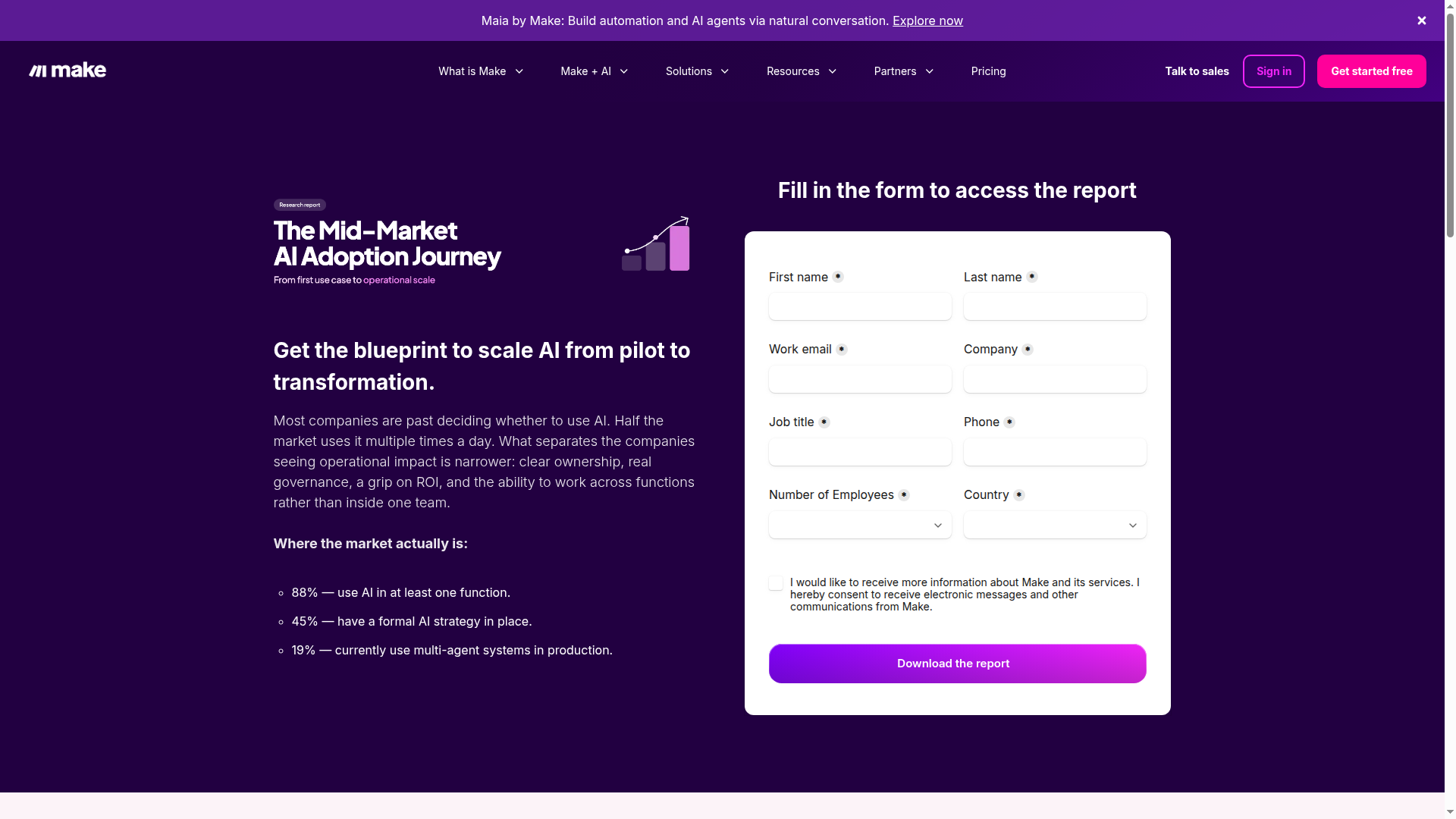
Make, the AI automation platform, has published The Mid-Market AI Adoption Journey, a report on why companies with roughly 250 to 1,000 employees struggle to turn working AI experiments into something the whole business runs on. Its conclusion is that the barrier is increasingly structural rather than technological.
According to Make, many mid-sized firms have plenty of AI use cases but lack the ownership, governance, process design and ROI logic needed to connect them into a scalable operating model. The organisations it interviewed described being held back not by a shortage of ideas, but by too many disconnected experiments and too little end-to-end visibility across workflows.
The numbers
- 45% of organisations have a formal AI strategy, according to the report.
- 40% of workers use AI multiple times a day, but organisational AI automation averages around 25%, according to Make's wider Business Agility Index.
- 88% of organisations use AI in at least one business function, citing McKinsey research, yet most remain in experimentation or piloting rather than operating at scale.
The report combines a Make-commissioned survey of 540 respondents across 16 industries and more than 35 countries, conducted with the Technical University of Munich, with Make AI Playbook data, customer insights and one-to-one interviews with business and AI leaders.
Size is a poor guide
Make argues that company size alone says little about AI readiness. Businesses with greater "AI proximity" - AI-enabled SaaS companies, cybersecurity providers, digital marketing agencies and consultancies - tend to move faster than manufacturers, logistics operators and retailers, which often need to model their existing processes first. Proximity is not enough on its own, though: even technology-led companies stall where leadership direction, ownership and governance are weak.
The report sets out three leadership modes. Permission encourages experimentation; pressure can increase activity without clear direction; and priority links AI to specific processes, named owners and defined outcomes. It also introduces two frameworks: the AI Adoption Profile, to diagnose where a business is starting from, and the AI Operational Scaling Model, for moving from isolated use cases to operational scale.
"Just being of similar size does not make for identical AI readiness: factors such as AI proximity, leadership, people readiness, and data readiness shape an organization's likely adoption path," said Daria Hvizdalova, Head of AI Adoption at Make. "Strong leadership and the right sharing culture can drive a move from first experiments to scaling across departments within months."
Darin Patterson, VP of Product Advocacy and Market Strategy at Make, who set out the findings on Make's blog on 10 September, said: "The hard step is not getting people to experiment with AI; it is turning those experiments into something the business can scale. That requires clear priorities around the processes that matter most, named owners and an end-to-end view of how the work actually gets done."
Patterson last spoke to Conversational AI News in September 2025, when he argued that automation must come before AI implementation.
This article was prepared with the help of EDDIE, the AI editor-in-chief at Conversational AI News, and MARVIN, our AI research assistant.