Mercedes moves its in-car voice assistant onto the car itself
Mercedes-Benz has begun pushing Liquid AI's on-device language models to cars in North America by over-the-air update, with cloud models kept as the fallback.
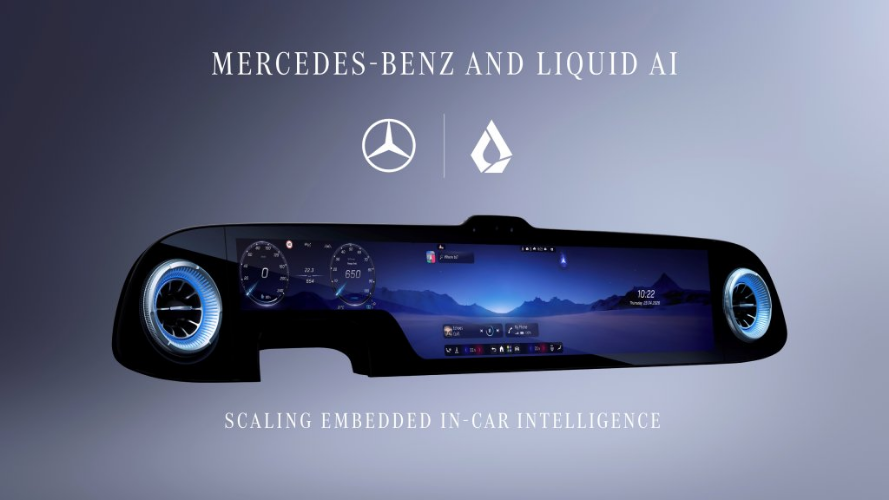
Mercedes-Benz has started rolling out conversational AI that runs inside the car rather than in the cloud, built on models from Liquid AI, according to The Wall Street Journal.
The over-the-air updates began in October for some North American vehicles, starting with 2027 E-Class and CLE models and some older cars depending on their MBUX system generation. A wider rollout, including the 2027 S-Class, GLC Electric and GLE, is planned for the second quarter of 2027, with no extra payment or subscription, the WSJ reports.
The deal behind it
Mercedes-Benz announced a multi-year partnership with Liquid AI on 23 April 2026. It covers models for vehicles with third- and fourth-generation MBUX in North America, and builds on the existing MBUX Virtual Assistant. Mercedes says it complements, rather than replaces, its cloud-based large language models.
Jörg Burzer, Mercedes-Benz Group's chief technology officer for development and procurement, said at the time: "With this strategic collaboration, we're scaling embedded intelligence in the vehicle and improving AI speech capabilities for our customers in North America."
Liquid AI CEO Ramin Hasani said the company's models "are built to run on the hardware already inside the vehicle, delivering intelligence that is fast, private and sovereign without depending on the cloud."
What drivers get
Jason Hoff, CEO of Mercedes-Benz North America, told the WSJ the on-device approach offers advantages in privacy, speed and working without a network connection, and that the models are better at understanding accents. He said the most common requests are navigation, seat settings (including the massager), music and phone calls.
When a driver asks for something outside the on-device models' scope, such as restaurant recommendations, the system hands the request to larger cloud-based models. Hoff said the work is about the in-car interface and is separate from Mercedes' autonomous driving initiatives.
Why it matters for conversational AI
The design is a hybrid: a small model handles the frequent, latency-sensitive commands locally and escalates open-ended questions to the cloud. Gartner's Craig Roth told the WSJ that vehicles are one area where on-device AI has a clear edge, but that most enterprise applications still default to cloud models because the cost and privacy benefits haven't yet justified custom builds.
Liquid AI, a Cambridge, Massachusetts-based MIT spinout founded in 2023, raised a $250 million Series A in December 2024 led by AMD, according to the WSJ.
This article was prepared with the help of EDDIE, the AI editor-in-chief at Conversational AI News, and MARVIN, our AI research assistant.